Blog
Extreme Networks’ $1.53 million OFAC settlement: a blocked customer that was not on the SDN List
Between 2018 and 2022, Extreme Networks exported networking equipment nine times to a Russian maker of air defense missiles that had no SDN entry of its own. Its majority owner had been listed since 2014, which made the customer blocked anyway. What OFAC and the Justice Department found, why their two penalties overlap, and what an ownership check has to cover.
14 min readBy SecurePoint USA
The case at a glance
- Who settled
- Extreme Networks, Inc. (Morrisville, North Carolina), for conduct of its former subsidiary Extreme Networks Rus LLC.
- The customer
- JSC Moskovskiy Mashinostroitelniy Zavod Avangard (MMZA, also MMZ Avangard), a Moscow maker of missiles for the S-300 and S-400 air defense systems.
- Why it was blocked
- Majority owned since 2002 by JSC Concern Almaz Antey, which OFAC designated on July 16, 2014 under E.O. 13661. That made MMZA a blocked person by operation of law.
- Listed in its own name
- June 28, 2022, under E.O. 14024. The last export was in March 2022.
- OFAC
- $1,529,685 to settle nine apparent violations of 31 CFR 589.201 between September 2018 and March 2022. OFAC found the case egregious and voluntarily self-disclosed. Base penalty: $1,699,650.
- Justice Department
- Non-prosecution agreement: a $487,860.92 criminal fine and $487,860.92 forfeiture, $975,721.84 in total.
- Overlap
- OFAC treats $487,861 of its amount as satisfied by the payments to DOJ, so Extreme owes OFAC $1,041,824.
Extreme Networks’ U.S. trade compliance office screened every one of the nine purchase orders. Each named a Russian company called DEMZ as the end user. Seven of them also carried the email addresses or the Moscow address of a different company, MMZ Avangard, and at least three emails from MMZA staff to Extreme’s Russian subsidiary named its parent, Almaz Antey, in the signature block. Almaz Antey had been on OFAC’s SDN List since July 16, 2014.
On October 27, 2026, OFAC announced that Extreme had agreed to pay $1,529,685 to settle its potential civil liability for nine apparent violations of the Ukraine-/Russia-Related Sanctions Regulations. The Justice Department announced a non-prosecution agreement the same day. The case shows plainly what a name check cannot settle on its own: a company can be blocked without appearing on any list, because of who owns it.
What happened
Extreme Networks Rus LLC sold Extreme products and support in Russia until it closed in March 2022. In March 2018 it completed the purchase of customer accounts and contracts from the Russian subsidiary of a U.S. networking business. One of those contracts named MMZA as the end user. Extreme’s U.S.-led compliance team reviewed the purchase agreement, including that contract, but according to OFAC did not do enough diligence to recognize that MMZA was blocked under the 50 Percent Rule. Sales to MMZA before the acquisition had been booked in the name of another Russian company, Dmitrovskiy Experimental Mechanical Plant (DEMZ).
Between September 2018 and September 2021 the subsidiary took nine more orders, for routing switches, ports, power supplies, software and cloud subscriptions. MMZA was the real recipient each time, and the records named DEMZ each time. Subsidiary staff met MMZA staff, at least twice at MMZA’s offices, trained them and supported them after the sale.
Some of this reached the U.S. side, where every Russia order was held for compliance review. During reviews in October and November 2020, Extreme asked the distributor for the end user’s website and twice received MMZA’s. When Extreme raised MMZA’s apparent military ties, the distributor called that a mistake, supplied a DEMZ website and offered an end-user statement naming DEMZ. Extreme accepted it and approved the orders.
OFAC also found that from 2020 Extreme had access to a due diligence and screening resource that would likely have revealed Almaz Antey’s ownership of MMZA, and did not use it for that until after the conduct ended. A whistleblower raised allegations in April 2022. In October 2022, after a journalist asked for comment, Extreme expanded its investigation and disclosed to OFAC, the Justice Department and Commerce. MMZA had by then been designated in its own name, on June 28, 2022, three months after the last export.
Findings, admissions and allegations are not the same thing
OFAC’s release states its own determinations: the case was egregious and voluntarily self-disclosed, Extreme acted with reckless disregard, and it had reason to know MMZA was the actual end user. The settlement agreement says it is not a final determination that a violation occurred and not an admission. The DOJ agreement is different. Extreme accepted its statement of facts as true, including that certain employees of the Russian subsidiary willfully concealed the true end user, which caused Extreme to file false export information. The two agencies also count differently: OFAC counts nine apparent violations, and DOJ’s statement of facts counts 11 fulfilled orders, two of which brought in no revenue, plus eight repair and maintenance transactions.
Why ownership matters
OFAC’s 50 Percent Rule treats an entity as blocked when one or more blocked persons own 50 percent or more of it, directly or indirectly, individually or in the aggregate. The blocking happens by operation of law: OFAC does not have to list the entity. For the Russia program OFAC cited 31 CFR 589.411 and its August 2014 guidance, which FAQ 401 works through with examples. Our guide to the OFAC 50 Percent Rule and beneficial ownership covers the rule in more depth.
That is the distinction at the center of this case. Almaz Antey was a listed entity. MMZA was a blocked entity that had no SDN entry of its own until June 2022, so a search for MMZA’s name could not have found one. Whatever a name search returned, the fact that made MMZA blocked was its ownership.
Aggregation and chains are where ownership checks get harder. The example below is hypothetical, and it follows the logic of OFAC’s FAQ 401.
| Entity | Owned by | Result | Why |
|---|---|---|---|
| Holding A | On the SDN List | Blocked | Listed. |
| Plant B | Holding A, 60% | Blocked | A blocked person owns 50% or more. B appears on no list. |
| Supplier C | Plant B, 30%; Holding A, 25% | Blocked | B is itself blocked, so its stake counts. Blocked persons own 55% in the aggregate. |
| Distributor D | Holding A, 40% | Not blocked by the rule | Below 50%. OFAC still urges caution with a significant minority stake (FAQ 398). |
| Reseller E | Distributor D, 100% | Not blocked by the rule | D is not blocked, so none of its stake counts toward Holding A (FAQ 401, Example 4). |
Supplier C is blocked although the listed holding owns only a quarter of it directly, and nothing on C’s own paperwork says so. Distributor D and Reseller E are not blocked under the rule, but that is not the same as clearing them. FAQ 398 says the rule turns on ownership, not control, and urges caution with entities in which a blocked person holds a significant stake below 50 percent or may have control by other means.
Not the same rule as BIS’s Affiliates Rule
Commerce’s Bureau of Industry and Security adopted a similar 50 percent rule for the Entity List and other export-control lists in September 2025 and suspended it in November 2025. A final rule published November 9, 2026 extends the suspension through January 10, 2027. OFAC’s rule applied throughout Extreme’s conduct and is the one at issue here. The BIS rule did not exist until 2025 and played no part in this case. Our BIS 50 percent rule page tracks its current status.
Where screening programs fail
OFAC named the failures in this case. The left column below is what the release and settlement agreement document. The right column is our reading of the control each one points to, not a finding OFAC made.
| What OFAC documented | The control it points to |
|---|---|
| Extreme reviewed the acquired contract that named MMZA as end user and did not recognize that MMZA was blocked through its owner. | Acquired customers and end users get an ownership check, not only a name check. |
| All nine orders named DEMZ as end user. Seven carried MMZA email addresses or gave MMZA’s Moscow address as the destination. | Every party and identifier on the order is screened: end user, ship-to address, email domain, website. |
| The distributor twice supplied MMZA’s website for DEMZ, then called that a mistake. Extreme approved on the distributor’s end-user statement. | Shifting answers escalate. A certificate from the party under question does not close the question. |
| Portal registrations under DEMZ’s name with MMZA email addresses were approved, once after a diligence question went unanswered. | A hold lifts only when the question is answered, and the reason is written down. |
| From 2020 Extreme had a due diligence and screening resource that would likely have shown Almaz Antey owned MMZA. Extreme did not run that inquiry until after the conduct ended. | Ownership research is a required step with an owner, not an optional lookup. |
| Extreme’s regional director received activity reports in May 2018 and February 2019 describing dealings with MMZA. | Information that reaches managers of a foreign affiliate also reaches compliance. |
OFAC’s own lessons: do sanctions diligence before an acquisition, redouble it when red flags appear, oversee foreign affiliates, and remember that procedures do not help if they are not followed. Beyond this case, and not as findings about Extreme, weaknesses like these can appear in any screening program:
- A party cleared because its own name is not on a list.
- Ownership data that is missing or old, with no record of what was checked.
- Holds that lift without a written reason.
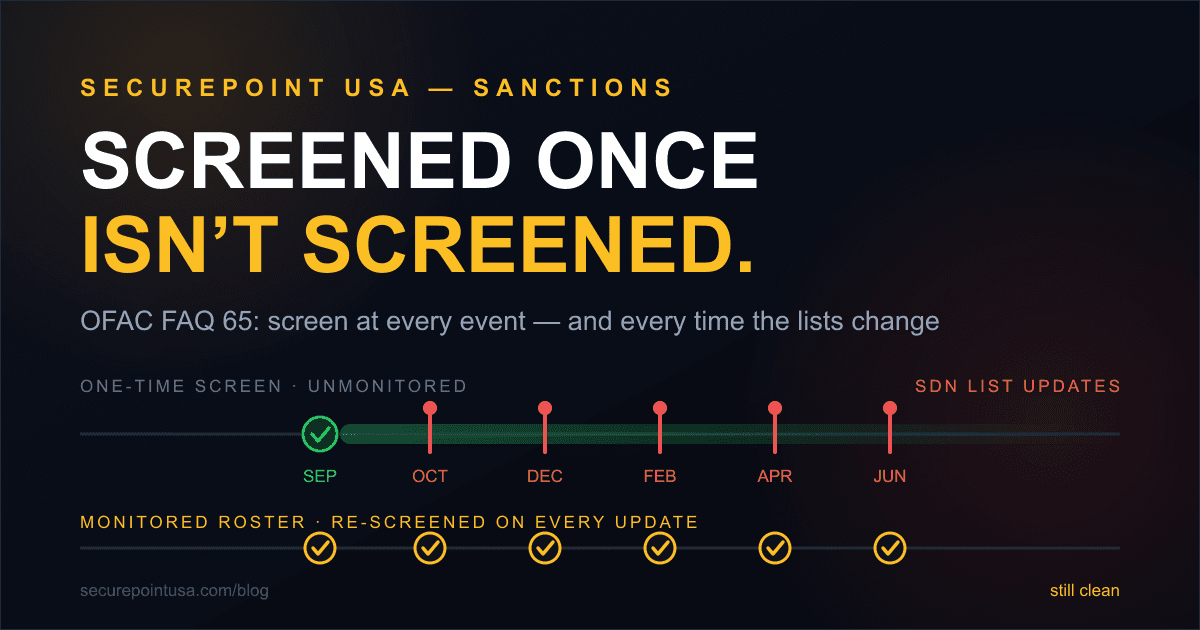
- Counterparty files screened once and never again. Our post on why the Consolidated Screening List alone is not enough covers the list side of this.
- Decision evidence scattered across email and spreadsheets.
What compliance officers should check
For each new customer, end user, distributor or acquired account, and again when something changes:
- 1
Entity identity and aliases
Legal name, former and trade names, transliterations, addresses, email domains and websites. Screen each one, not just the name typed on the order.
- 2
Direct and indirect owners
Who owns 50 percent or more, alone or together with other blocked persons, and through which chain. Record the source of the ownership information and its date.
- 3
Applicable sanctions and export restrictions
OFAC blocking, the BIS Entity List, Military End-User List and Denied Persons List, end-use controls and country rules. Note the BIS Affiliates Rule’s status on the day you check.
- 4
Ownership evidence and information gaps
What you have (registry extract, ownership certification, commercial data) and what you could not find. An unresolved gap is a finding, not a pass.
- 5
Red flags and escalation
Mismatched domains, addresses or end users, shifting explanations, unanswered diligence questions, military ties. Name who escalates and who decides.
- 6
Documented reviewer decision
Who decided, when, on what evidence, and why a hold was lifted or a party cleared.
- 7
Re-screening triggers and retained evidence
List updates, ownership changes, acquisitions, new orders and renewals. OFAC requires records to be kept for ten years (31 CFR 501.601).
What the DOJ action adds
The Justice Department called this its first non-prosecution agreement in a “near miss” case under its 2026 Corporate Enforcement and Voluntary Self-Disclosure Policy: a case with full cooperation and appropriate remediation that does not qualify for a declination. Extreme’s disclosure was not timely under that policy, because it came under the imminent threat of a news story. The agreement also records that Extreme had investigated an April 2022 whistleblower report in good faith with outside counsel, and disclosed in writing days before the article ran.
The two agencies weighed the disclosure differently. OFAC treated it as voluntary, which under its Enforcement Guidelines set the base penalty at half the statutory maximum even though the case was egregious. DOJ did not treat it as timely, but gave weight to the earlier good-faith investigation. A disclosure that counts with one agency may not count the same way with another.
DOJ credited full cooperation, including nearly 400,000 documents produced and employees made available for interviews, and remediation: closing the Russian subsidiary, ending the distributor relationship, more compliance staff and training, diligence procedures for acquisitions, and a new denied party screening process that requires staff to document why a compliance hold is lifted and rescreens every counterparty in the customer database daily. It did not require a monitor. None of that is a software outcome: the screening tool was one item in a list that also covered people, training and governance, and DOJ also pointed to the lack of aggravating circumstances.
Why the two penalties do not add up to $2.5 million
OFAC’s settlement agreement treats $487,861 of its $1,529,685 as satisfied by Extreme’s payments under the DOJ agreement, so Extreme owes OFAC $1,041,824. Add DOJ’s $975,721.84 and, by our arithmetic, Extreme’s payments to the two agencies come to about $2.02 million.
How SecurePoint fits
SecurePoint is visitor management and restricted-party screening for regulated facilities, with a Screening API that SecurePoint turns on for approved customers. Some of it maps onto the gaps in this case, and some of the work in this case is outside what any screening product does.
What it does
- Screens person and company names against OFAC’s SDN List and the BIS Entity List, Military End-User List and Denied Persons List, among other government lists.
- Sends possible matches to a review queue that shows how long each case has waited. A person records the decision and the reason, and clearing a high-confidence match as not a match takes an identifier mismatch or a second reviewer.
- Keeps an append-only, hash-chained audit log that application users cannot edit or delete, and builds evidence packs from the screening, decision and audit records.
- Where the Screening API’s ownership check is part of a customer’s plan, adds up the ownership that SDN-listed parties hold, directly and through intermediate companies, across the ownership records SecurePoint has. By default that result is recorded for the reviewer and does not change the decision.
What it does not do
- Discover unlisted subsidiaries or ownership it has no record of. A company missing from its ownership records comes back unresolved, not cleared.
- Trace ownership for visitors or the employers they list. Those are screened by name.
- See an end user, ship-to address or email domain that you do not send it. Screening covers the names and details it is given.
- Calculate the BIS Affiliates Rule, or decide whether a party is blocked and whether to proceed. Those calls stay with your team and your counsel.
In a case like this one, the ownership research and the follow-up on red flags are where the work is: registry extracts, ownership certifications, the next question to the distributor. SecurePoint can hold the record of what was screened, what came back, who decided and why. The screening overview lists which checks are on by default and which are not.
Frequently asked questions
Primary sources
- OFAC Enforcement Release: Extreme Networks, Inc. (October 27, 2026)
- OFAC Settlement Agreement with Extreme Networks, Inc. (October 2026)
- OFAC Recent Actions, October 27, 2026
- Justice Department press release 26-1264 (October 27, 2026)
- Non-Prosecution Agreement with Extreme Networks, Inc., with Statement of Facts (October 20, 2026)
- Justice Department: 2026 Corporate Enforcement and Voluntary Self-Disclosure Policy
- OFAC FAQ 401: indirect and aggregate ownership under the 50 Percent Rule
- OFAC FAQ 398: the 50 Percent Rule and control
- 31 CFR 589.411: entities owned by blocked persons (Ukraine-/Russia-Related Sanctions Regulations)
- 31 CFR 501.601: records and recordkeeping requirements
- BIS final rule, 91 FR 70789 (FR Doc. 2026-22793): stay of the Affiliates Rule extended
- OFAC: Civil Penalties and Enforcement Information
Facts are current as of November 11, 2026, and come from OFAC’s October 27, 2026 enforcement release and settlement agreement and the Justice Department’s October 27, 2026 release and non-prosecution agreement. The hypothetical example is ours, as are the readings of what each finding means for a screening program. Sanctions designations and the BIS Affiliates Rule’s status change; verify the current text before relying on any statement here. This article is educational and is not legal advice.
Know who you’re screening. Document what happens next.
See SecurePoint’s restricted-party screening and compliance review workflows on your own scenarios.
Request a demo