
Source-backed comparison
SecurePoint USA vs Veristream (Building Intelligence)
SecurePoint and Veristream solve different security problems. SecurePoint is built for sanctions-screened visitor access, adjudication, ITAR/EAR/CMMC evidence, and after-visit exports. Veristream (now part of Building Intelligence) is stronger when the buyer needs integrated visitor, vendor, and vehicle security for secure and critical-infrastructure facilities, with license-plate recognition and DHS SAFETY Act and SOC 2 certifications.
Based on SecurePoint product capabilities and publicly available materials reviewed on 2026-06-18.
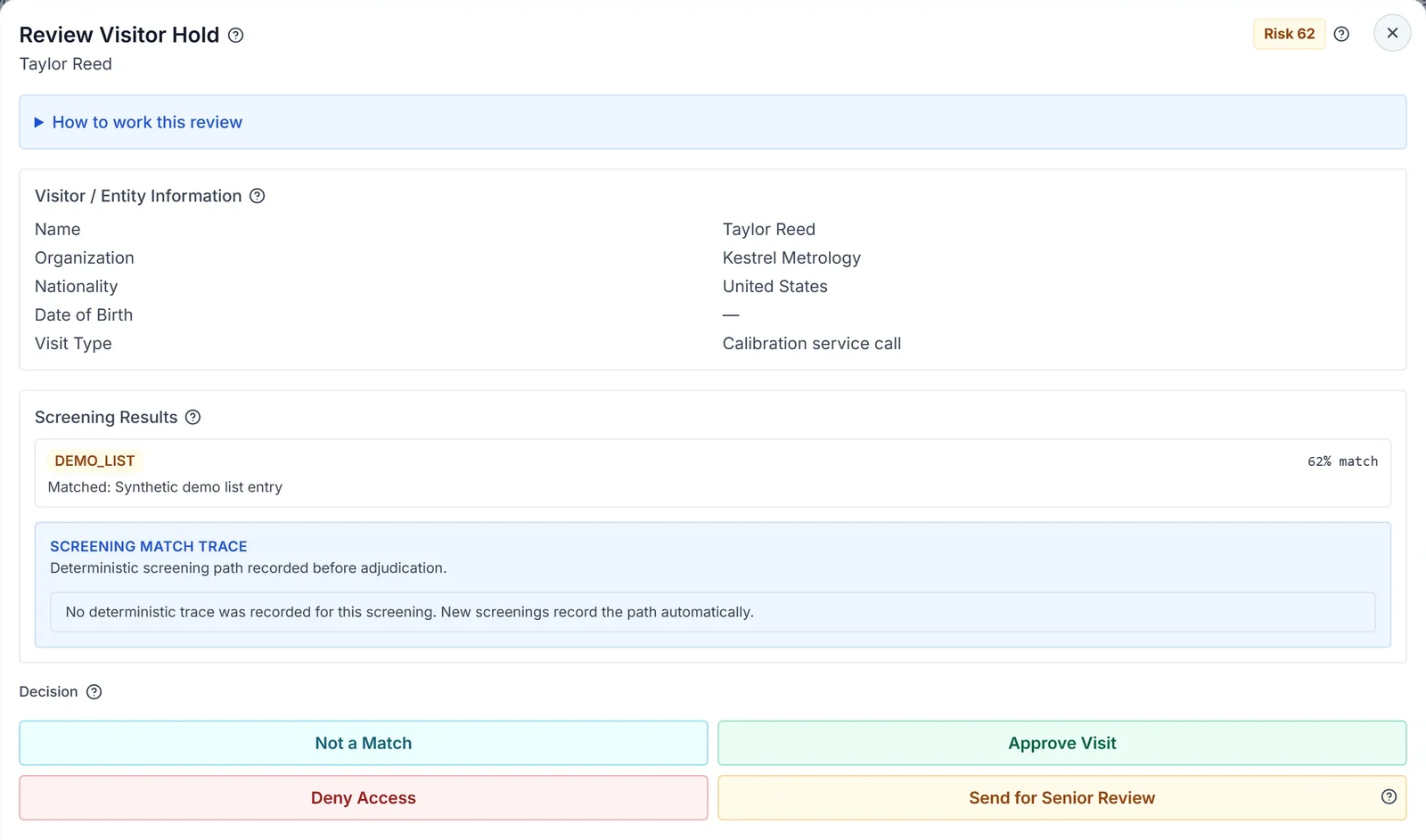
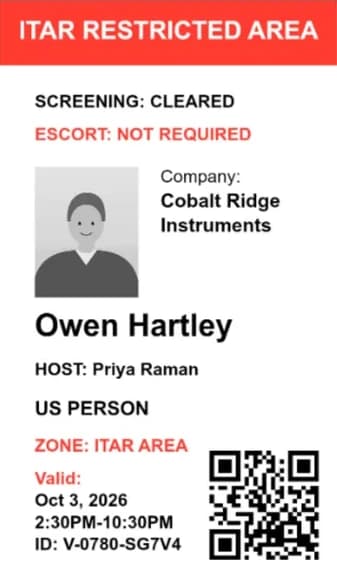
Pictured: a held possible match and a badge preview from a demo organization with fictional visitors.
Choose SecurePoint if
Your visitor program is driven by sanctions and export-control screening depth, not vehicle and perimeter security infrastructure.
Visitors, contractors, hosts, or education parties need OFAC SDN and BIS Entity List screening tied to the visit record.
Your buyer is an FSO, export-control lead, compliance manager, or auditor who needs reviewer decisions and evidence exports.
ITAR, EAR, CMMC, or sanctions-screening records must be produced quickly without rebuilding spreadsheets after the visit.
Choose Veristream / Building Intelligence if
You need integrated visitor, vendor, and vehicle security for a secure or critical-infrastructure facility.
Vehicle management, license-plate recognition, loading-dock control, and perimeter access are required in the same system.
DHS SAFETY Act and SOC 2 physical-security certifications are a procurement requirement.
Your primary buyer is physical security operations rather than export-control compliance.
Comparison
Where the approaches actually separate
This table only includes points we can support from SecurePoint's current product capabilities and publicly available materials.
Product focus
Purpose-built around sanctions-screened visitor access, structured adjudication, and after-visit compliance evidence for export-controlled and regulated facilities.
Veristream is now part of Building Intelligence; its SV3 platform manages visitors, vendors, and vehicles in one system for secure facility access, with iVisitor as its enterprise visitor-management product.
Sanctions and export-control screening
Screens visitors and related parties against OFAC SDN, BIS Entity List, UN, EU, and UK lists at check-in, then records the result for review and evidence.
Public materials describe watchlist and unauthorized-access prevention through automated approvals; OFAC, BIS, ITAR, and CMMC sanctions/export-control screening is not described as a primary public product claim.
Vehicle and physical-perimeter security
Focuses on the visitor compliance workflow (check-in, screening, adjudication, badge, and evidence) rather than vehicle, loading-dock, or perimeter security hardware.
Public materials describe vehicle management with license-plate recognition (LPR), UVIS, video integrations, loading-dock and entrance access control, and vendor/vehicle pre-vetting.
Match review and after-visit evidence
Possible visitor matches route to adjudication with reviewer action and badge/host/escort context, then export as an evidence pack for ITAR, EAR, or CMMC review.
Public materials describe approvals, real-time monitoring, and recordkeeping for secure access; a sanctions-match adjudication record and bundled export-control evidence pack are not described as primary public capabilities.
Security certifications and posture
Positioned around compliance-screening depth and audit evidence for export-control and CMMC visitor workflows; certification posture is communicated per program rather than as a public seal today.
Public materials state SV3 is DHS SAFETY Act certified and SOC 2 certified, with a long track record across transportation, stadiums, healthcare, and critical-infrastructure sites.
Education and sanctions-only screening
Also screens education parties (students, tuition payors, sponsors, donors) against OFAC and global sanctions lists through SecurePoint Education, with continuous monitoring and evidence packs.
Public materials center on secure physical-facility access for vendors, vehicles, and visitors; OFAC screening of education or financial counterparties is not a described use case.
Neutral Read
Where Veristream / Building Intelligence is stronger today
A credible comparison should separate physical-facility security breadth from sanctions-screening depth.
Vehicle, vendor, and visitor in one platform
SV3 publicly combines visitor, vendor, and vehicle management with license-plate recognition, UVIS, and video integrations. Sites that need perimeter, loading-dock, and vehicle access control in one system may prefer that breadth.
Certified secure-facility track record
Public materials describe DHS SAFETY Act certification, SOC 2 certification, and deployments across transportation, stadiums, healthcare, and critical infrastructure. That is stronger public physical-security proof than SecurePoint publishes today.
Physical-security integration depth
Building Intelligence is positioned around hardware-integrated perimeter security: gates, docks, cameras, and LPR. SecurePoint should not imply equivalent physical-security infrastructure depth.
Trust And Proof
What SecurePoint delivers today
The comparison above describes each product from its own public materials. This is ours, running. Anything claimed for SecurePoint on this page is something you can ask to see in a walkthrough.
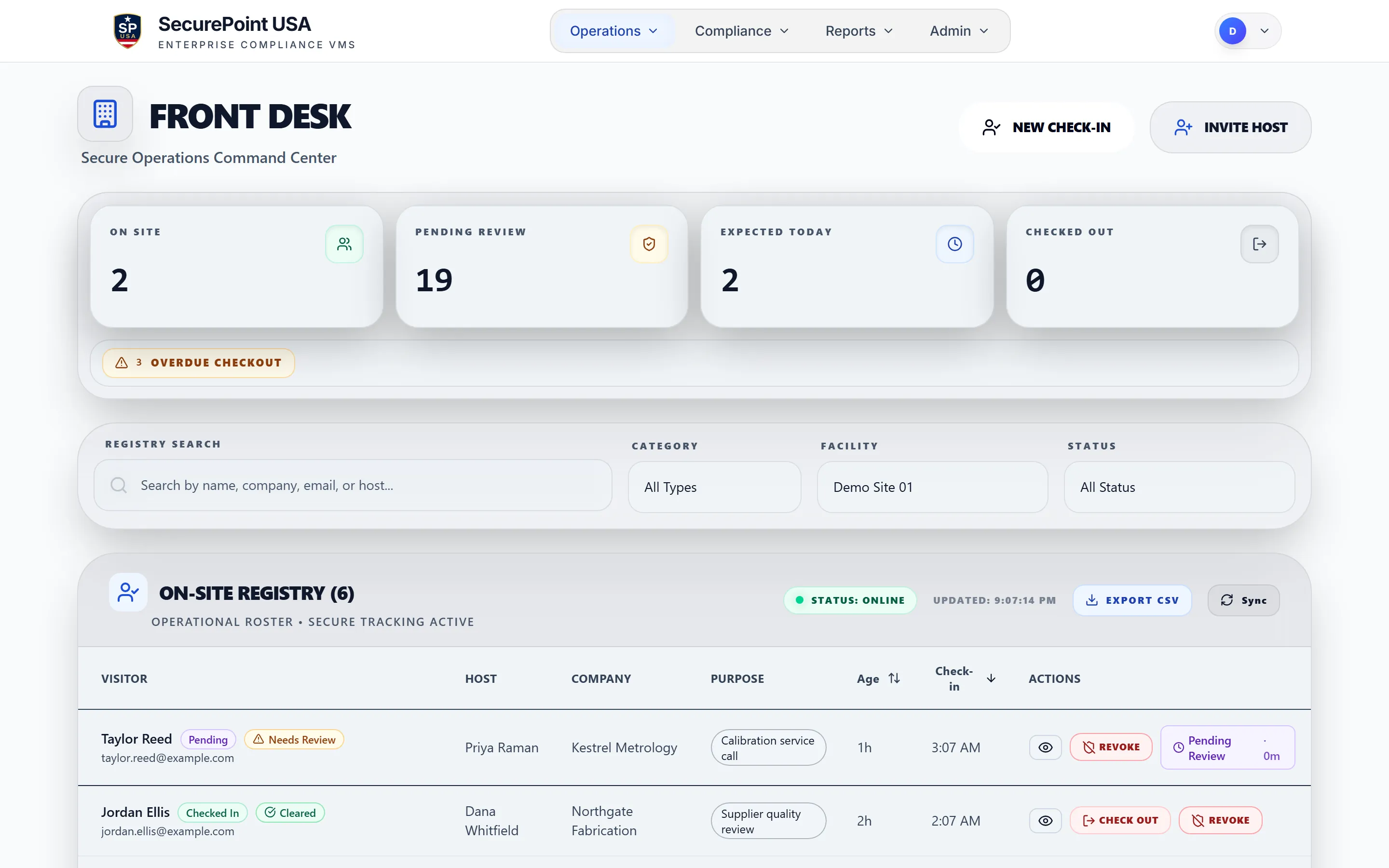
Swipe to pan the screen
Watch a possible match get reviewed
A visitor is screened at check-in, a possible match holds the visit, and a reviewer records the decision and the reason before it continues.
Read the transcript
Visitors are screened against sanctions and denied-party lists, like OFAC's SDN list, the BIS Entity List and Denied Persons List, and the UN, UK and EU sanctions lists.
When a name comes back as a possible match to someone on a list, the visit is held. No badge can print until a person reviews it.
The case goes to the compliance queue, which shows how long each review has been waiting.
Open it to see exactly what matched: the listed name, the list it's on, and how closely the names compare.
Compare that with what you know about the visitor. Then record your decision and the reason: not a match, approve, deny, or send it for senior review.
The decision is saved with who made it and when, and the visit can continue.
SecurePoint Visitor. Screen visitors at check-in, and keep the decisions on record.
Sanctions-screened visitor access
SecurePoint screens visitors against OFAC SDN, BIS Entity List, UN, EU, and UK lists during the visit workflow and records the result.
ITAR and CMMC visitor evidence
SecurePoint Visitor pages and whitepapers are built around export-control visitor workflows, escort evidence, badge records, and physical access logs.
After-visit evidence packs
After-visit reports and evidence packs connect screening, adjudication, badge, host, and escort facts into one audit-ready export.
Frequently asked questions
When is SecurePoint the better fit than Veristream / Building Intelligence?
SecurePoint is the better fit when the requirement is sanctions-screened visitor compliance: OFAC SDN and BIS Entity List screening, ITAR and EAR visitor controls, CMMC visitor evidence, structured adjudication, and after-visit evidence packs. It is not trying to replace perimeter, vehicle, or loading-dock security infrastructure.
Where is Veristream / Building Intelligence stronger?
Building Intelligence is stronger for secure physical-facility access at scale: SV3 combines visitor, vendor, and vehicle management with license-plate recognition, UVIS, and video, backed by DHS SAFETY Act and SOC 2 certifications and a long critical-infrastructure track record.
Can SecurePoint replace SV3 for physical-perimeter security?
No. SecurePoint should be evaluated for compliance-screened visitor management and export-control evidence. SV3 should be evaluated for integrated visitor, vendor, and vehicle security at secure facilities. Some organizations may run both, serving different workflows.
What should defense contractors compare first?
Start with the risk that drives the requirement. If the risk is whether a visitor or counterparty appears on a sanctions or export-control list, compare OFAC/BIS screening, adjudication, ITAR/EAR/CMMC evidence, and evidence-pack export. If the risk is vehicles and perimeter access at a secure site, compare vehicle management, LPR, and physical-security integrations.
Keep Comparing
Other alternatives buyers evaluate
Every comparison uses the same neutral format and notes where the alternative is stronger.
SecurePoint vs Envoy
Compliance-first screening and adjudication versus a broad enterprise workplace platform.
SecurePoint vs iLobby
Sanctions-screened visitor access compared with iLobby VisitorOS and FacilityOS.
SecurePoint vs Sign In Solutions
For defense and regulated facilities weighing compliance depth against workplace breadth.
SecurePoint vs Proxyclick (Eptura Visitor)
US export-control screening, adjudication, and audit evidence versus broader enterprise worktech.
SecurePoint vs LobbyGuard
Sanctions screening versus background-check-oriented visitor management for schools and facilities.
SecurePoint vs FacilityOS
A dedicated compliance VMS compared with a broader facilities management suite.
See the compliance-screening visitor workflow end to end
Walk through check-in, sanctions screening, possible-match review, badge state, and after-visit evidence in one focused demo.