
Source-Backed Comparison
SecurePoint USA vs Sanction Scanner
SecurePoint and Sanction Scanner both screen against sanctions lists, but they screen different things. SecurePoint screens the people tied to a physical visit or facility-access event — visitors, contractors, vendors, hosts, and education parties — then adjudicates, badges, and exports compliance evidence. Sanction Scanner is an AML and financial-crime platform that screens customers, transactions, and payments for banks, fintechs, and payment providers.
Based on SecurePoint product capabilities and publicly available materials reviewed on 2026-06-18.
Choose SecurePoint if
You need to screen who enters a facility (or who pays a school) and prove it — not monitor financial transactions.
The subject of screening is a visitor, contractor, vendor, host, or education party tied to a physical access or payment event.
You need check-in, adjudication, badging, host/escort records, and an after-visit evidence pack in one workflow.
ITAR, EAR, CMMC, or OFAC education-screening records must be produced for an auditor or assessor.
Choose Sanction Scanner if
You are building an anti-money-laundering or KYC program for a financial institution.
The subject of screening is a financial customer, beneficial owner, transaction, or payment.
You need transaction monitoring, payment/remittance screening, PEP, and adverse media at financial-institution scale.
You want an API-first engine to embed screening and ongoing monitoring into onboarding and payment systems.
Comparison
Where the approaches actually separate
This table only includes points we can support from SecurePoint's current product capabilities and publicly available materials.
Primary use case
Built for sanctions-screened visitor access at regulated facilities: kiosk and front-desk check-in, host coordination, badge state, adjudication, and after-visit evidence.
Built for anti-money-laundering (AML) and financial-crime compliance: screening customers, transactions, and payments for banks, fintechs, and financial institutions.
What gets screened
Screens the people and parties tied to a physical visit or facility-access event — visitors, contractors, vendors, hosts, and education parties — against sanctions and export-control lists.
Public materials describe screening customers, beneficial owners, transactions, payments, remittances, and even vessels and aircraft for financial-crime risk.
List and data coverage
Screens against OFAC SDN, BIS Entity List, UN, EU, and UK lists with US export-control depth (ITAR/EAR/CMMC context) for facility-access decisions.
Public materials describe very broad AML coverage — sanctions, PEP, adverse media, and watchlists drawn from thousands of lists across many countries for financial-crime screening.
Operational workflow
Screening is embedded in the visitor workflow: check-in, possible-match adjudication, badge issuance, host/escort record, checkout, and evidence export happen together.
Public materials describe an API-first screening and ongoing-monitoring engine designed to embed into onboarding, KYC, and payment systems rather than a front-desk visitor workflow.
Audit evidence
After-visit evidence packs connect visitor identity, screening outcome, badge, host/escort, and reviewer decision into one export for ITAR, EAR, or CMMC audits.
Public materials describe AML audit trails, case management, and ongoing-monitoring records suited to financial-regulator examinations rather than facility-access or export-control evidence.
Target market
Regulated facilities, defense-adjacent manufacturers, and schools that must document who entered or who paid, and prove it for an auditor or assessor.
Public materials center on banks, fintechs, payment providers, and financial institutions building AML and KYC compliance programs.
Neutral Read
Where Sanction Scanner is stronger today
A credible comparison should separate AML and financial-crime screening from facility-access screening.
AML and financial-crime breadth
Sanction Scanner publicly covers transaction monitoring, payment and remittance screening, ultimate-beneficial-owner checks, PEP, and adverse media at financial-institution scale. SecurePoint does not position itself as an AML transaction-monitoring platform.
API-first screening engine
Public materials describe a detailed REST API and many integration options for embedding screening and ongoing monitoring into onboarding and payment flows — a strong fit for fintech and banking systems.
Financial-services list and market depth
Public materials describe coverage drawn from thousands of sanctions, PEP, and watchlists across many countries for financial-crime use. Buyers screening financial counterparties at high volume may prefer that AML-specialized depth.
Trust And Proof
What SecurePoint delivers today
The comparison above describes each product from its own public materials. This is ours, running. Anything claimed for SecurePoint on this page is something you can ask to see in a walkthrough.
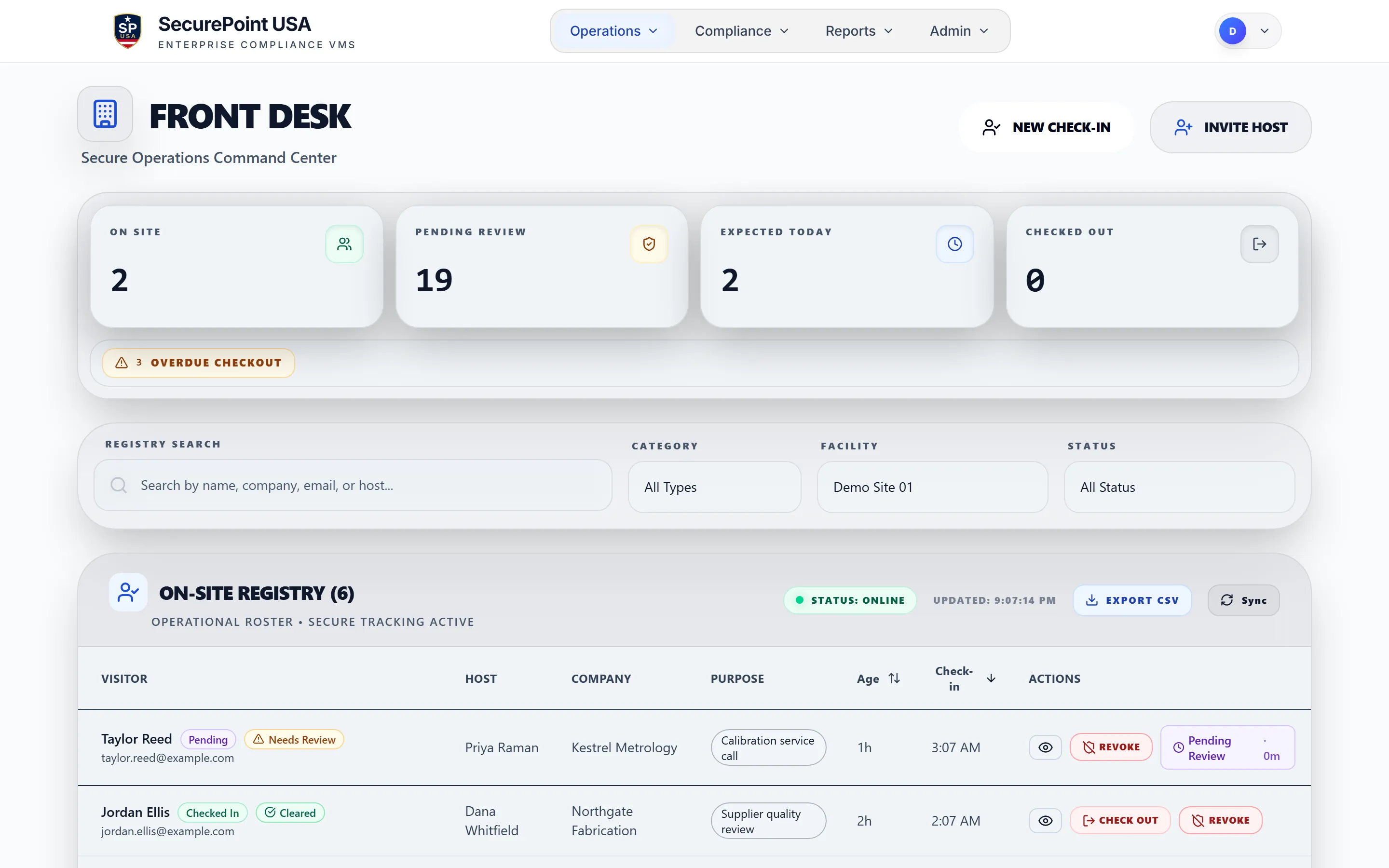
Swipe to pan the screen
Sanctions-screened visitor access
SecurePoint screens visitors against OFAC SDN, BIS Entity List, UN, EU, and UK lists during the visit workflow and records the result.
OFAC screening for schools
SecurePoint Education screens students, tuition payors, sponsors, and donors against OFAC and global sanctions lists, with continuous monitoring and evidence packs.
After-visit evidence packs
After-visit reports and evidence packs connect screening, adjudication, badge, host, and escort facts into one audit-ready export.
Frequently asked questions
When is SecurePoint the better fit than Sanction Scanner?
SecurePoint is the better fit when the requirement is facility-access compliance: screening the people tied to a physical visit — visitors, contractors, vendors, hosts, or education parties — against OFAC and export-control lists, then adjudicating, badging, and exporting evidence. It is a visitor-management and evidence system, not an AML transaction-monitoring platform.
Where is Sanction Scanner stronger?
Sanction Scanner is stronger for anti-money-laundering and financial-crime compliance: screening customers, beneficial owners, transactions, and payments, with PEP and adverse-media coverage and ongoing monitoring built for banks, fintechs, and payment providers.
Can SecurePoint replace an AML screening tool?
No. SecurePoint screens the people connected to a physical visit or facility-access event and produces visitor compliance evidence. An AML tool like Sanction Scanner screens financial customers and transactions for money-laundering risk. They serve different programs and can coexist.
What should a compliance team compare first?
Decide what you are actually screening. If it is the people entering a facility or the parties paying a school, compare visitor check-in, sanctions screening, adjudication, and evidence export. If it is financial customers, transactions, and payments, compare AML monitoring, KYC onboarding, and case management.
Keep Comparing
Other alternatives buyers evaluate
Every comparison uses the same neutral format and notes where the alternative is stronger.
SecurePoint vs Descartes Visual Compliance
Restricted-party screening applied to visitor access versus trade-compliance screening workflows.
SecurePoint vs Envoy
Compliance-first screening and adjudication versus a broad enterprise workplace platform.
SecurePoint vs iLobby
Sanctions-screened visitor access compared with iLobby VisitorOS and FacilityOS.
SecurePoint vs Sign In Solutions
For defense and regulated facilities weighing compliance depth against workplace breadth.
SecurePoint vs Proxyclick (Eptura Visitor)
US export-control screening, adjudication, and audit evidence versus broader enterprise worktech.
SecurePoint vs Veristream
Sanctions screening compared with Building Intelligence SV3 secure physical-facility access.
See facility-access screening and evidence end to end
Walk through check-in, sanctions screening, possible-match review, badge state, and after-visit evidence in one focused demo.