What is the BIS 50% rule?
The BIS 50% rule applies Entity List and MEU List restrictions to any entity that is 50% or more owned, directly or indirectly, by listed parties. This mirrors OFAC's longstanding 50% rule for SDN ownership.
How does ownership aggregation work?
The system traverses all ownership paths from a target entity upward. If multiple listed owners each hold partial stakes, their percentages are summed. For example, if Owner A (listed) holds 30% and Owner B (listed) holds 25%, the aggregate is 55%.
What sanctions lists are checked?
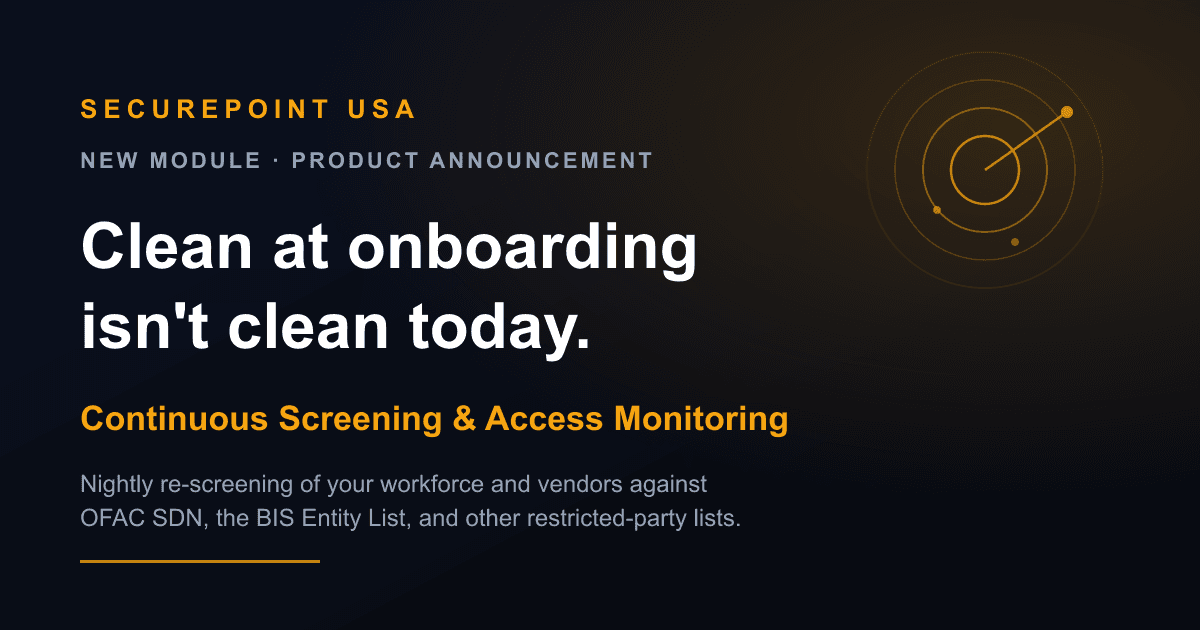
Screening runs against OFAC SDN and SSI, the BIS Entity List (which carries the MEU sub-list) and Denied Persons List, FBI Most Wanted, Federal Reserve enforcement actions, the UFLPA Entity List and Section 1260H, and non-US sources alongside them: UK OFSI, the EU Financial Sanctions Facility, the UN Security Council consolidated list, France’s DGT asset freezing list, Singapore MAS enforcement actions, INTERPOL Red Notices, the OpenSanctions aggregated dataset, World Bank debarment and Inter-American Development Bank sanctions. Several further sources are maintained but stay off unless an organization turns them on, including the BIS Unverified List, the ITAR/DDTC debarred list, SAM exclusions, LEIE and politically exposed persons. Confirm which sources your own tenant has enabled rather than assuming everything is active.
Can I import my own ownership data?
Yes. You can upload ownership relationships via CSV or add them manually through the admin interface. The calculation engine uses whatever data you provide.
What is included in the Evidence Pack?
The Evidence Pack is a timestamped record containing: entity name searched, ownership chain discovered, sanctions lists checked, aggregate percentage calculated, and query timestamp. This is documentation for your compliance files.
Is this tool legal advice?
No. This tool performs calculations based on data you provide. It does not constitute legal advice, guarantee regulatory compliance, or replace consultation with qualified export control counsel.
How long does a typical lookup take?
It depends on the ownership graph. An entity with one direct owner has a single path to evaluate, while an entity held through several layers of holding companies has many more, so it takes longer. We do not publish a typical lookup time.
What happens after the beta?
Beta participants will have early access to the production release and input on feature priorities. Pricing will be announced separately.