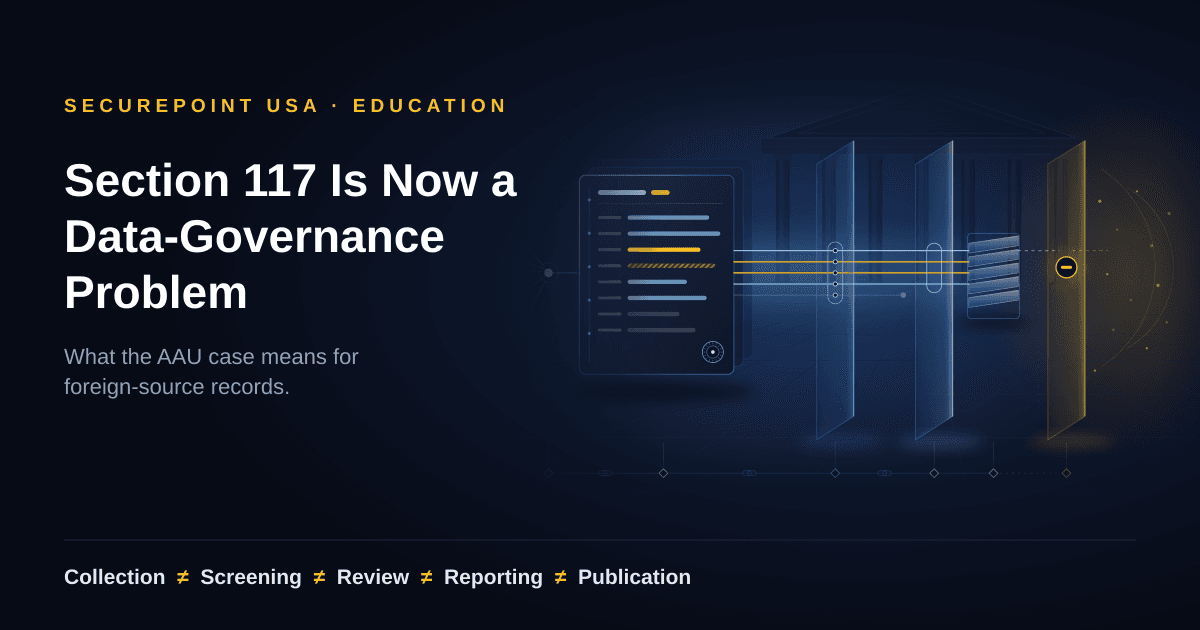
The disclosure was already in the file.
Research security enforcement rarely turns on facts nobody knew. It turns on facts an organization had written down, in its own systems, that never reached the certification it signed. That is a reconciliation problem, and reconciliation is a records problem.
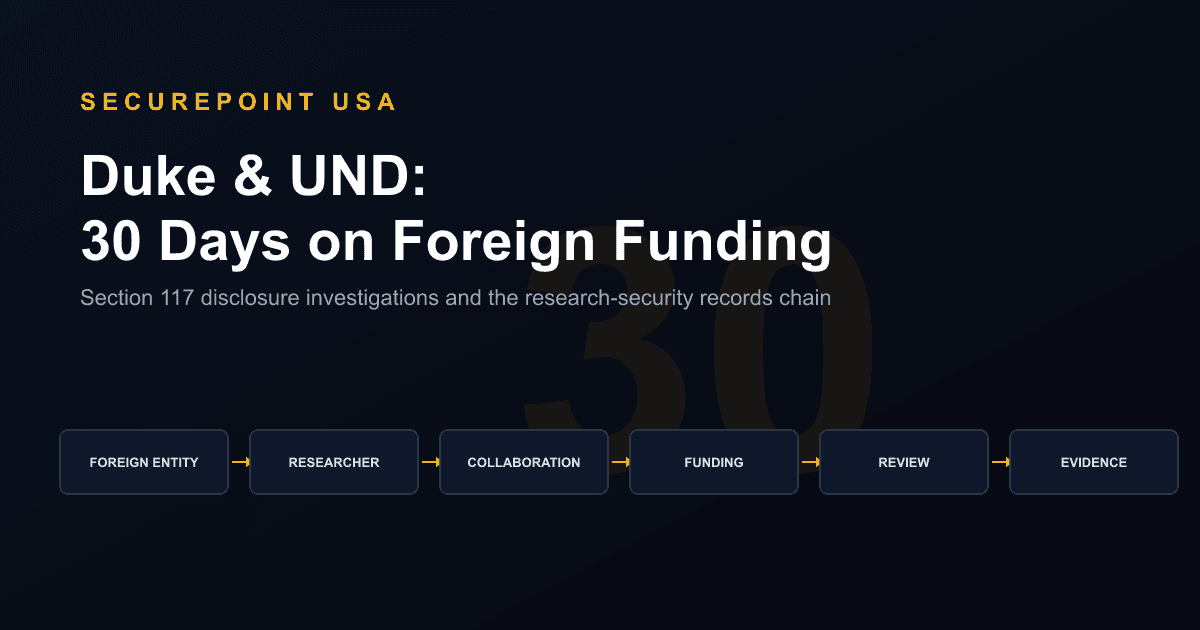
Two things happened on August 31, 2026. Thirty U.S. academic institutions faced a Department of War deadline to report the results of an ordered review of their academic, financial, and research collaborations with foreign entities of concern, including institutions named under Section 1286 of the FY19 National Defense Authorization Act. On that same date, a settlement agreement was executed between the Department of Justice, acting for NASA and the National Science Foundation, and a major public research university, resolving civil claims for $2.1 million in restitution.
Read together, the two documents describe the same week from opposite ends. One tells institutions to go find these relationships. The other shows the cost when an institution already had them.
The failure was linkage, not discovery
The detail that matters most in the settlement is not that a relationship was hidden. According to the agreement, the researcher’s guest, adjunct, visiting, and advisory positions with foreign universities and state-run research organizations were reported on annual faculty activity reports submitted to his own department, since at least 2014.
The institution held the information for roughly a decade. What the United States contended is that it never reached the grant applications or the requests to draw down grant funds. Two systems of record inside one organization, never compared.
A second gap in the same document is about elapsed time rather than linkage. The agreement recites that the institution learned of foreign talent program participation in September 2019 and disclosed it to the funding agencies in 2023. Knowing something and owing someone that knowledge are different events, and the interval between them is itself reviewable.
No watchlist would have closed either gap
Denied-party screening answers a question about the day it runs. Neither failure here was a question about a single day. One was a join that never happened between two internal records; the other was a clock that nobody started when an obligation attached.
This is not only a university problem
The same structure appears wherever an organization collects affiliation information once and certifies something to the government later. A cleared contractor onboards a foreign national and records their prior employer. A national laboratory approves a visiting researcher and notes their home institution. Two years on, that person is working under a different contract, in a different area, against a different set of representations, and nothing re-examined the affiliation captured on day one.
The exposure is not hypothetical. The August 2026 agreement expressly reserves, rather than releases, False Claims Act liability, Program Fraud Civil Remedies Act liability, criminal liability, individual liability, and every federal agency’s suspension and debarment rights. A payment resolved a civil monetary claim. It did not close those doors.
Four questions to ask about your own file
Where does affiliation live?
If foreign affiliation is captured as free text on an onboarding or intake form and never normalized, it cannot be compared to anything. A field you cannot query is not a control.
What re-examines it?
A point-in-time check answers a question about the day it ran. An affiliation that was true in 2014 and still true in 2019 only resurfaces if something looks again on a schedule.
Can you prove what you knew, and when?
The hardest question in a retrospective review is reconstructing your own timeline. If that reconstruction depends on email threads and spreadsheets, it is an argument rather than a record.
Did you record why you proceeded?
Most relationships reviewed in an audit are legitimate and continue. An undocumented approval and an unexamined one look identical two years later.
What a defensible record actually contains
The lesson generalizes past research grants. If an access or eligibility decision can be reopened years later, three properties decide whether you can defend it: the decision is linked to the information available when it was made, the position is maintained rather than decided once, and the reasoning is recorded at the time rather than reconstructed afterward.
SecurePoint screens parties against OFAC SDN and consolidated lists and the BIS Entity List, flags potential matches for human review, and maintains a timestamped audit trail of who decided what and when. Those records support the access-control and accountability evidence that compliance programs are built on. They are one control inside a program, not the program. Disclosure reconciliation, grant certifications, and license determinations remain the organization’s own.
Frequently asked questions
According to the settlement agreement, the researcher reported his guest, adjunct, visiting, and advisory positions with foreign universities and state-run research organizations on annual faculty activity reports submitted to his own department since at least 2014. The United States contended those affiliations never reached the grant applications or the requests to draw down grant funds. The institution held the information; two internal systems of record were never compared. The university denies the allegations and the agreement is expressly not an admission of liability.
Primary sources
- DOJ: Settlement Agreement (NASA / NSF, executed August 31, 2026)
- Department of War: Research Security Audits at 30 Academic Institutions
- OUSD(R&E): FY25 NDAA Section 1286 List
- False Claims Act: 31 U.S.C. §§ 3729–3733
Enforcement postures, list contents, and program requirements change. Verify current status against the issuing agency before relying on any statement here. The settlement described above is a civil resolution in which the institution denies the allegations and which is expressly not an admission of liability. This article is general information, not legal advice.
See what the record looks like
Screening, human review, and a timestamped decision trail on one record: walk through it with our team.
Request a demo