
Government and public sector
Visitor management for government agencies.
Screen visitors and contractors against sanctions lists, with SAM and LEIE exclusion screening switched on when your programs call for it. Every decision goes into an append-only audit trail, and visit records export for the date range and site a records request covers.
Pictured: the kiosk and a badge printed by SecurePoint, from a demo organization with fictional visitors.
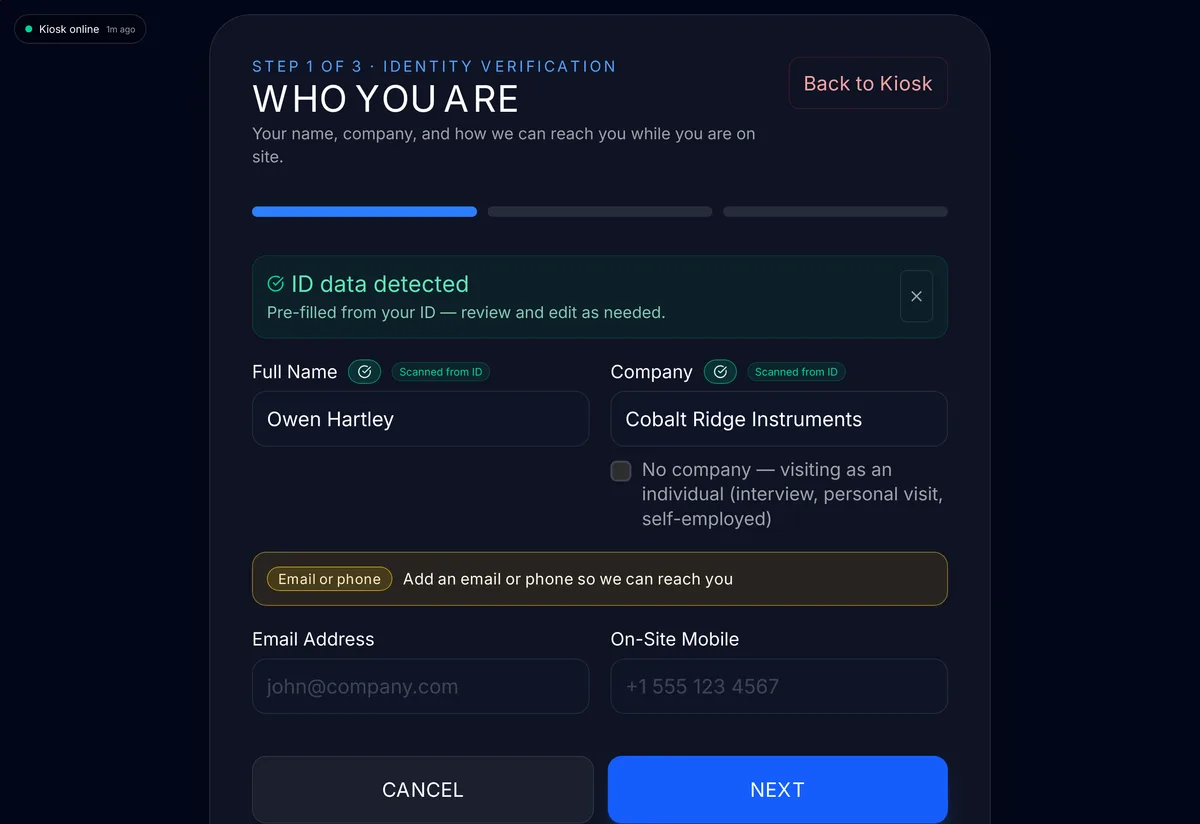
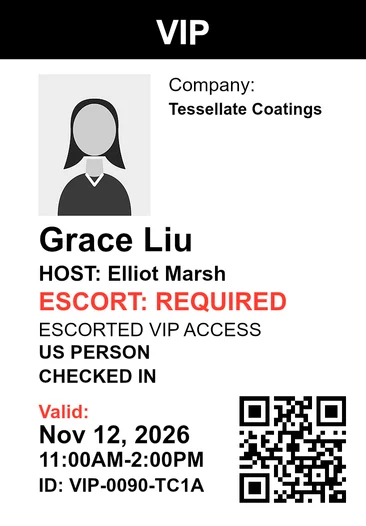
- Sanctions screening by default
- OFAC, BIS, UN, UK and EU lists, when a visitor registers or at the kiosk.
- SAM and LEIE on request
- Exclusion screening is off by default and switched on per organization.
- Held for a person
- A possible match waits for a reviewer, who records the decision and a reason.
- Steps by visitor type
- A contractor type can require an NDA, a safety briefing or an escort.
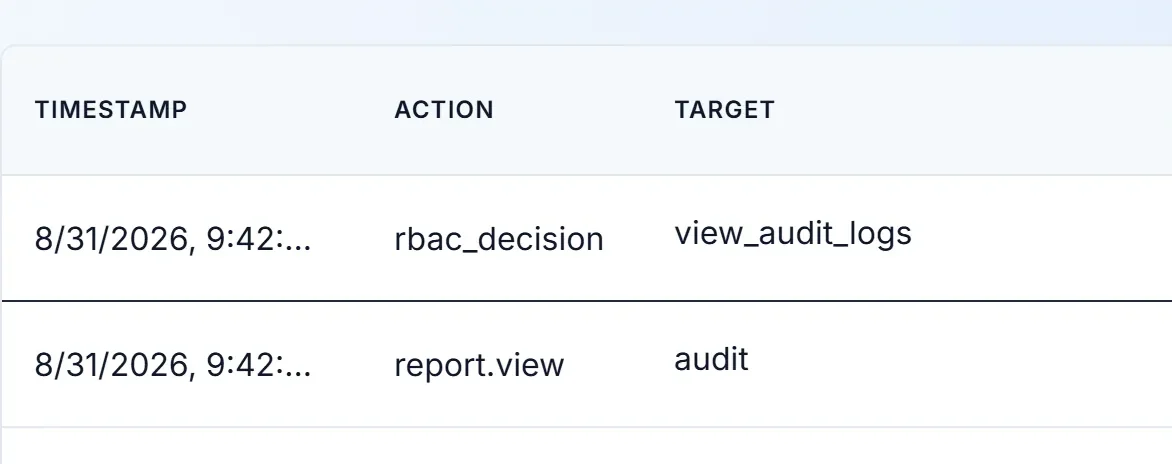
- Append-only audit trail
- Hash-chained, with a verifier. Application users can't edit or delete it.
- Exports for records requests
- By date range and site, with personal fields in full, pseudonymized or withheld.
Sanctions and exclusion screening, with a person deciding.
Exclusion and debarment lists answer whether a party is barred from federal programs or contracting. Sanctions lists answer whether a party is designated. SecurePoint can check both in the same screening.
| Source | Status | What it means |
|---|---|---|
| OFAC SDN and SSI listsU.S. Treasury | On by default | Checked when a visitor registers, or at the kiosk for walk-ins. |
| BIS Entity List and Denied Persons ListU.S. Commerce | On by default | Export-control lists, checked in the same screening. |
| UN, UK and EU sanctionsUnited Nations, UK FCDO, European Union | On by default | International sanctions, checked in the same screening. Each list refreshes on its own schedule. |
| SAM exclusionsU.S. General Services Administration | Off by default | Switched on for an organization that asks. A possible match then goes to review like any other. |
| List of Excluded Individuals and Entities (LEIE)HHS Office of Inspector General | Off by default | Switched on for an organization that asks, in the same way as SAM. |
A possible match waits for a reviewer.
The visit holds, and the case goes to a review queue with SLA tracking. A reviewer compares the details and records a decision and a reason. Name matching is fuzzy matching, not AI.
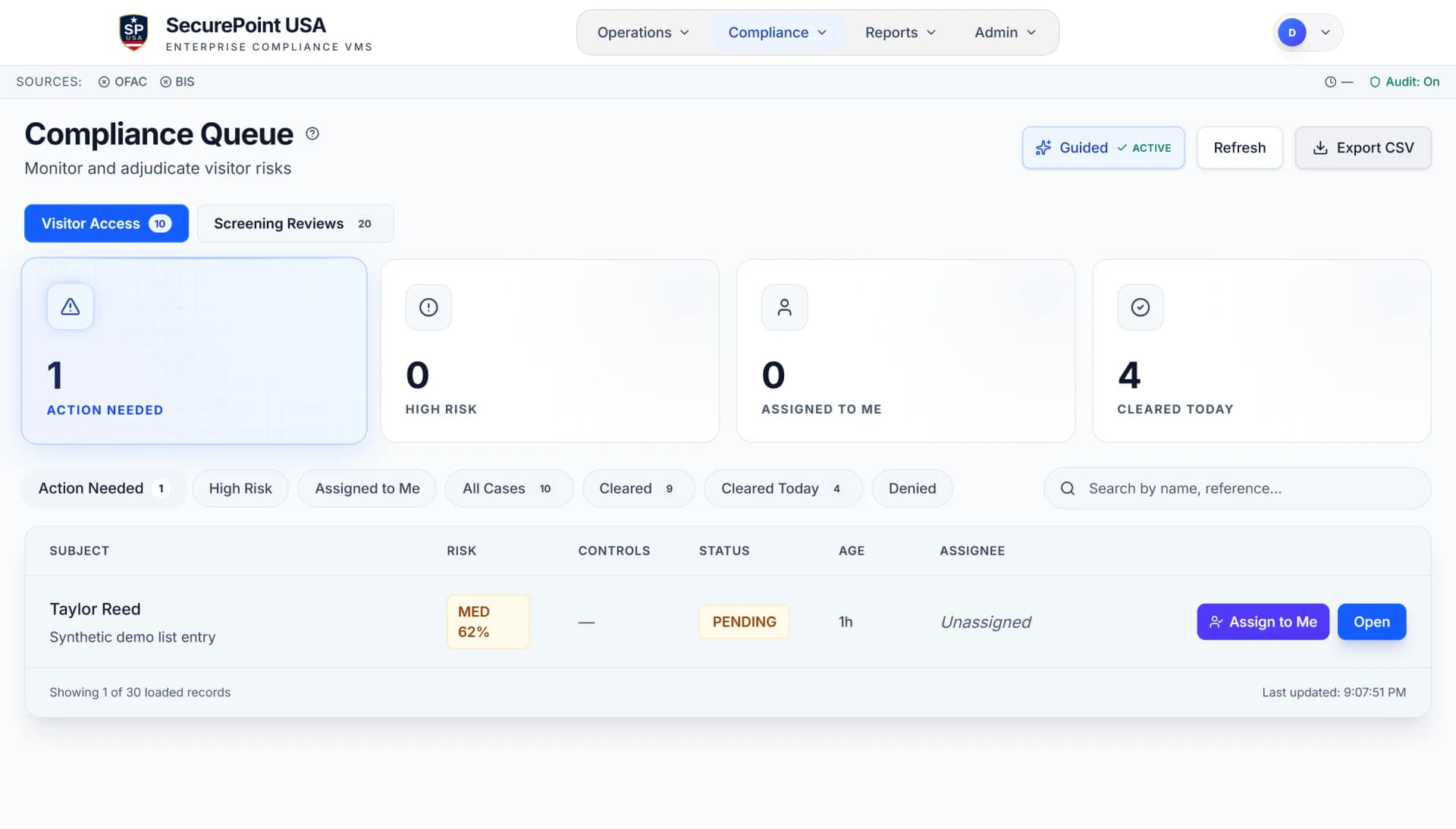
Records requests, by date range and site.
Export visit records, decisions and the audit trail for the period and site a request covers. What to release or withhold stays with your FOIA officer and counsel.
Personal fields, your way.
An evidence pack can carry personal fields in full, replace them with pseudonyms that stay consistent within the pack. Withholding them entirely is available through the API.
Behind every export sits an append-only, hash-chained audit log that application users cannot edit or delete, with a verifier that checks the chain.
Watch an evidence pack being built.
An admin picks a template and a date range, and SecurePoint builds a ZIP of screening results, review decisions and audit records, with a manifest that lists an SHA-256 checksum for each file. Evidence Pack History keeps each sealed pack, so a later download is the same file.
Read the transcript
When an auditor asks how visitors were screened, an admin opens the Evidence Center and picks a template and a date range.
SecurePoint builds a ZIP file with screening results, review decisions and audit records from that period, and its manifest lists an SHA-256 checksum for each file.
Evidence Pack History keeps each sealed pack, so a later download is the same file, with the same checksum.
The audit ledger shows who did what, and when: check-ins, screening results, reviewer decisions, and exports.
Users can't edit or delete ledger records, and exports from this page come with an SHA-256 checksum.
SecurePoint Visitor. Screen visitors at check-in, and keep the decisions on record.
How a contractor visit runs.
Each site sets its own steps, and a visitor type can add its own: a contractor type can require an NDA, a safety briefing or, at kiosk check-in, an escort.
- 1
The host invites, and the visitor is screened
Screening runs when the visitor registers, with SAM and LEIE where they are switched on. Walk-ins are screened at the kiosk.
- 2
The kiosk checks them in
Depending on the site's rules: QR code, ID capture, badge photo, the NDA and the safety briefing.
- 3
A person reviews any possible match
The visit is held until a reviewer decides. Who decided, when, and a reason go on the record.
- 4
The host is told and the badge prints
When the checks clear, the host gets an email or text, and the badge prints at the kiosk or the desk.
For your security review.
Each line says whether a control is built in, documented, or still planned. SecurePoint does not claim FedRAMP authorization.
| Area | Status | What it means |
|---|---|---|
| Sign-in and access | Built in | Microsoft Entra ID single sign-on on every plan, MFA enforced by organization policy, and role-based permissions. |
| Hosting and data | Built in | The application runs on Vercel and the database on Supabase, both in U.S. West regions. Each organization's data is separated by row-level security. |
| Audit trail | Built in | Append-only audit log, SHA-256 hash-chained, with an integrity check every day. |
| Record retention | Built in | Screening and review records can't be deleted for 10 years. |
| Subprocessors | Published | Named list with purposes. The AI providers that summarize screened names and read ID text at browser kiosks both run until an administrator turns them off. |
| SOC 2 Type II | Not certified | Controls are mapped to the Trust Services Criteria. The Q3 2027 target is not a commitment. |
| Penetration test | Planned | No third-party test has been performed yet. Internal security review is ongoing. |
Related pages
See a contractor visit, start to finish.
We'll screen a contractor, hold a possible match, and export the records for one site and one month.
Frequently asked questions
- Which exclusion lists does SecurePoint check for a public agency?
- The GSA SAM exclusions list and the HHS-OIG LEIE, alongside sanctions and denied-party screening. Both exclusion lists are off by default and switched on per organization. Which sources apply to your agency is your decision, under your programs and your own policy.
- Is exclusion screening the same as sanctions screening?
- No. Exclusion and debarment lists answer whether a party is barred from federal programs or contracting. Sanctions lists answer whether a party is designated. They are separate lists, and SecurePoint can check both in the same screening.
- Can visitor records be produced for a FOIA request?
- Visit records, decisions and the audit trail export for a date range and site of your choosing. What is releasable under FOIA, and what must be withheld or redacted, is a determination for your FOIA officer and counsel, not something a system decides.
- Can the record be altered after the fact?
- Not by application users. Visits and decisions go into an append-only, hash-chained audit log that application users cannot edit or delete, with a verifier that checks the chain.
- Where is the data hosted?
- The application runs on Vercel and the database on Supabase, both in U.S. West regions. Each organization's data is separated by row-level security.
- Does SecurePoint make our agency compliant?
- No. Compliance is a program your agency runs. SecurePoint is one internal control inside it, and the record that shows the control operated. The obligation stays with your agency.