Screening Tuition Payers, Sponsors, and Donors Alongside Blackbaud
A school’s OFAC obligation belongs to the institution that accepts the money. Here is who has to be screened, and how the screening, the review, and the evidence run beside the records your school already keeps.
Independent schools run enrollment, tuition, and advancement on serious software, and most of them run it well. The records are complete, the families are known, the payments reconcile. Then an auditor asks a question that no system of record was ever meant to answer: “Show me that you screened this family before you accepted their money.”
That question is not about software. It is about who holds the obligation, and the answer is that the school does.
The obligation attaches to the institution
OFAC rules apply to U.S. persons, and a school is one. What the rules prohibit is the dealing itself: a U.S. person may not transact in the property or interests in property of a blocked person. Civil liability is strict, which means a violation can stand without intent and without knowledge.
That is why the obligation cannot be handed to a vendor. It is not a feature that some system holds on your behalf. It attaches to the institution that enters the tuition agreement and accepts the funds, and it stays there. What a school can do is put a documented control in front of the transaction and keep the record that proves the control ran.
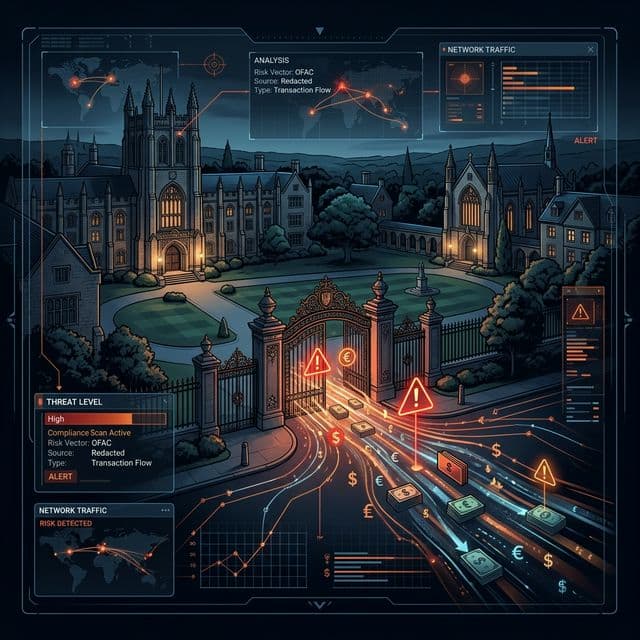
In February 2026, OFAC settled with a Florida school and athletic academy for $1.72 million over 89 apparent violations of the counternarcotics sanctions regulations. The school had entered yearly tuition agreements with two individuals on the Specially Designated Nationals list and processed their payments across several years. The names had been public the entire time. The parties who went unscreened were the tuition-paying parents, not the enrolled students. We covered the enforcement action itself in Your Payment Processor Isn’t Your Compliance Program.
A system of record and a compliance control do different jobs
Your system of record holds the authoritative picture of your community: who is enrolled, who is billed, who gives. That is the job Blackbaud Education Management and Blackbaud Raiser’s Edge NXT do for schools, and it is the reason the data is worth screening in the first place. A compliance control takes those parties, checks them against restricted party sources, routes anything that looks like a match to a person who decides, and keeps the timestamped record of the decision. The two are complementary. SecurePoint USA is the second one, and it runs beside your records without changing them.
Who a school actually screens
The enrolled student is rarely the party that carries the risk. The money arrives from somewhere else, and the screening scope has to follow the money rather than the roster.
The payer who is not the parent
Tuition is wired by an overseas relative, a family office, or a sponsoring company. That party is on the transaction, so that party belongs in the screening scope.
Donors and foundations
Advancement accepts gifts, grants, and endowment funding from individuals and institutions. A blocked donor is a prohibited transaction regardless of the school’s intent.
Parties who clear, then change
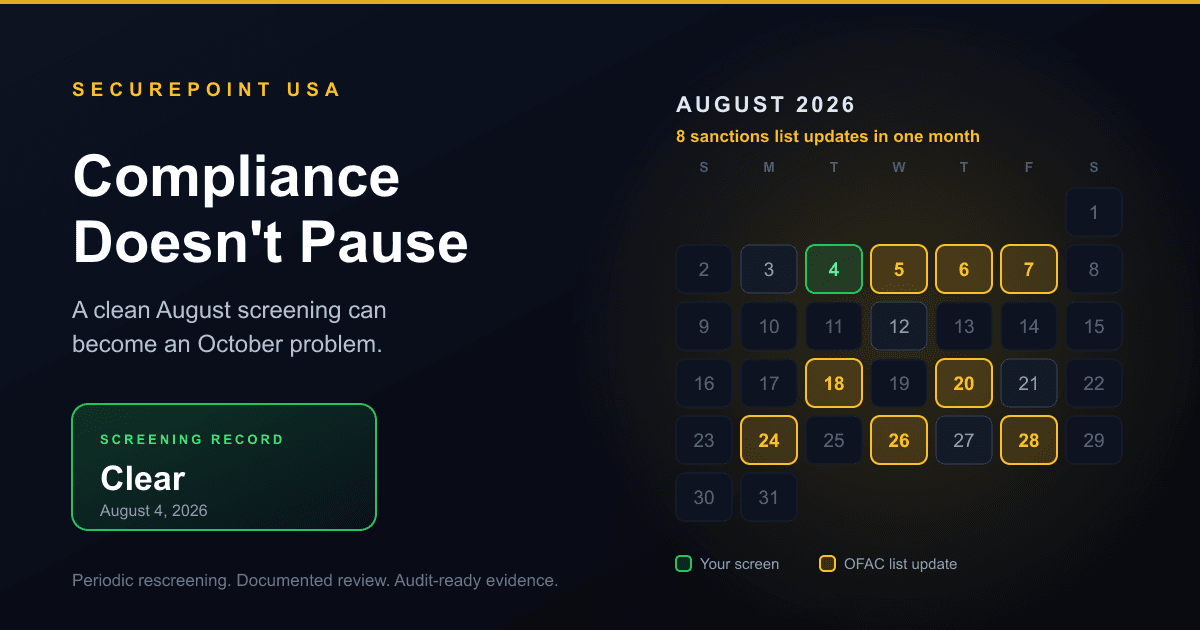
A family clears in August and is designated in November. Enrollment lasts a year, so a single screening at intake is a snapshot rather than a control.
The record, three years later
The question an auditor asks is whether you screened, not whether you were paid. A payment record shows the transaction settled. It does not show the check happened.
How the screening runs beside your records
Nothing has to be connected, installed, or integrated before a business office can screen its first roster. How quickly a school starts is up to that office.
- Bring the parties across. Schools on Blackbaud Education Management import students, guardians, and tuition payers straight from the connector. Everyone else, and every advancement team exporting donors and foundations, uploads a CSV. Both paths land in the same review queue.
- Screen every party. Each one is checked against OFAC SDN, OFAC Sectoral Sanctions Identifications, the BIS Entity List and Denied Persons List, and UN, EU, and UK OFSI sources. Clear results resolve on their own, so reviewers only handle what genuinely needs a decision.
- Review what surfaces. Potential matches arrive in a queue carrying the matched name, source list, sanctions program, confidence, and country context. A person decides and records the rationale, and that record cannot be edited afterward.
- Keep the evidence. Any screening exports as an evidence pack: the result, the reviewer, the timestamp, and the regulatory context, available for prior years as well as this one.
Rescreening runs on a configurable 30- or 90-day cycle, defaulting to 30, so a mid-year designation surfaces before the next invoice goes out. When a party does flag, SecurePoint assesses whether an OFAC General License may authorize the transaction and prepares Specific License documentation for your counsel. That is an assessment, not a filing: SecurePoint does not file with OFAC and does not give legal advice.
Where the connector stands today
The SecurePoint USA Education Compliance Connector is built on the Blackbaud SKY API and is listed on Blackbaud Marketplace. It authorizes once against Blackbaud Education Management, checks which records and screening fields your environment exposes, and saves that connection so nobody has to authorize again. It requests read access only and never writes to or deletes anything in your records. Blackbaud stays your system of record.
Roster import is available now. Students, guardians, and tuition payers come across with the date of birth, citizenship, and tuition-responsible-signer fields that make screening accurate. Scheduled sync is not available yet: nothing re-reads Blackbaud on its own, so an administrator imports again whenever the roster changes. CSV import remains available on every plan for rosters that do not live in Blackbaud.
What this looks like in practice
A school keeps its enrollment, billing, and advancement data exactly where it is. Once a term, or on whatever cadence the business office already runs, the parties in those records are screened, the small number that surface get a human decision with a recorded rationale, and the evidence sits ready for whoever eventually asks. The system of record keeps doing its job. The compliance control does the one thing that is specifically the school’s to do.
Primary sources
- OFAC enforcement release, February 12, 2026 (IMG Academy, LLC settlement)
- OFAC Specially Designated Nationals and Blocked Persons List
- 31 CFR Part 598, Foreign Narcotics Kingpin Sanctions Regulations
Sanctions listings and enforcement guidance change. Verify current status against the primary sources above. This article is general information about compliance operations and is not legal advice.
See it against your own roster
Book a school compliance review. We will walk your business office through screening, human review, and the evidence pack, using the party types your school actually handles.
Request an Education demoOfficial member of

Blackbaud, Raiser’s Edge NXT, Education Management, and SKY API are registered trademarks of Blackbaud, Inc. SecurePoint USA is an independent partner and is not affiliated with Blackbaud, Inc. in any other capacity. SecurePoint USA provides sanctions screening software and does not provide legal advice, does not file with OFAC on behalf of customers, and does not represent that use of its software constitutes certification or regulatory approval.