
Process Comparison
SecurePoint vs Manual OFAC Checks
Many organizations start their visitor compliance program with manual OFAC SDN searches. SecurePoint replaces that process with automated real-time screening, structured adjudication, and a durable audit trail, without requiring staff to remember to run a search before every check-in.
Based on SecurePoint product capabilities and OFAC public guidance reviewed on 2026-04-04.
Choose SecurePoint if
You need a documented, scalable OFAC compliance process that produces an audit-ready record for every visitor, without depending on staff to run checks manually.
Every visitor check-in needs a timestamped screening record that can be produced for an ITAR, CMMC, or OFAC audit.
False-positive matches need a documented adjudication trail, not just a verbal review.
You operate multiple sites or have visitor volume where manual checks are becoming operationally burdensome.
Manual checks may be sufficient if
Your visitor volume is very low and you have the discipline to maintain a documented search log.
You have very few visitor events per week and someone consistently runs and documents every check.
You are in the earliest stage of building a compliance program and a software subscription is not yet justified.
You only need to screen against the OFAC SDN list and do not need BIS, UN, EU, or UK list coverage.
Comparison
Where the approaches actually separate
This table only includes points we can support from SecurePoint's current product capabilities and publicly available materials.
Audit trail and reviewer documentation
Every screening event, match result, reviewer decision, and adjudication note is captured automatically in a durable, timestamped record exportable for audit.
Manual searches produce no automatic audit trail. Organizations must document each search, the date, who ran it, the result, and any follow-up action in a separate log, typically a spreadsheet or case note.
Sanctions list coverage
Screens against OFAC SDN, BIS Entity List, UN Consolidated, EU Consolidated, and UK Sanctions lists in a single check. Lists update automatically.
OFAC's free search tool covers the SDN list. Checking BIS, UN, EU, and UK lists requires separate manual searches on separate government or third-party sites.
Integration with the visitor check-in flow
Screening runs automatically at visitor check-in. Flagged visitors are held in a review queue before receiving a badge, without requiring a separate manual step.
A manual check is a separate step that must be run before or during check-in. Enforcement depends entirely on staff remembering to run the check and acting on the result.
False-positive adjudication
Fuzzy-match results route to a structured adjudication queue. Reviewers document the match analysis, resolution rationale, and approval, creating a defensible record of the decision.
Reviewing a potential match manually requires the compliance officer to assess name similarity, DOB, nationality, and other identifiers and then document the decision separately.
Scalability across sites and visitor volume
Handles multi-site visitor volume with a single platform. Audit records for all sites are centralized and consistent.
Manual checks scale linearly with headcount. Each site requires someone responsible for running checks, and records across sites are rarely consolidated.
Cost to start
Requires a software subscription. Published pricing starts at defined tiers for defense visitor programs.
OFAC's search tool is free. The cost is staff time and the operational burden of a manual, undocumented process.
Neutral Read
Where manual OFAC checks have a real advantage
Honest about where a manual process is genuinely sufficient, and where the tradeoff tips toward automation.
Zero software cost to start
OFAC's search tool is publicly available at no charge. For organizations just starting a compliance program or with very low visitor volume, it is a genuine starting point before a software investment is warranted.
Compliance teams already know the tool
OFAC's SDN search is widely understood by compliance officers. No onboarding, integration, or training budget is needed to begin manual checks.
No implementation dependency
Manual checks can begin immediately. There is no procurement cycle, no integration project, and no IT dependency to resolve before the first search is run.
Trust And Proof
What SecurePoint delivers today
The comparison above describes each product from its own public materials. This is ours, running. Anything claimed for SecurePoint on this page is something you can ask to see in a walkthrough.
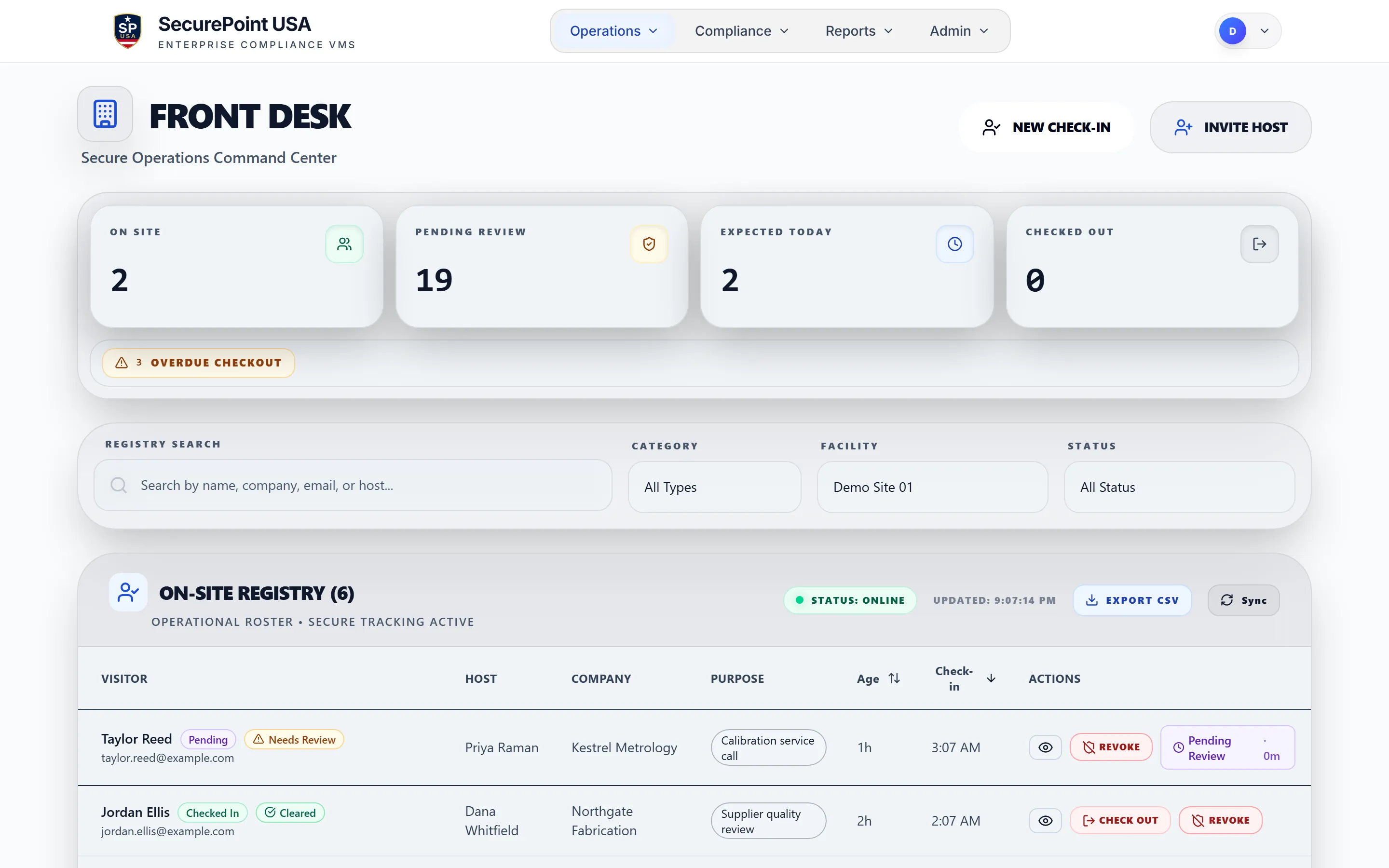
Swipe to pan the screen
Multi-list screening in one step
SecurePoint screens OFAC SDN, BIS Entity List, UN, EU, and UK lists at check-in, without requiring separate manual searches across government sites.
Structured adjudication record
Potential matches route to a reviewer queue. Resolution rationale and approver are captured automatically. No separate log required.
After-visit evidence packs
Screening outcomes, adjudication notes, and visitor records export in a single bundle ready for ITAR, CMMC, or OFAC audit review.
Frequently asked questions
Is manual OFAC search sufficient for a regulated facility?
OFAC does not specify how searches must be conducted, so a manual process is not automatically non-compliant. However, OFAC's own guidance emphasizes that organizations should implement a risk-based compliance program. For facilities with regular visitor volume, a manual process creates audit-trail gaps, false-positive documentation risk, and scalability problems that a software-based system addresses.
What are the main risks of relying on manual OFAC checks?
The primary risks are: no automatic audit trail of every search and decision, single-list coverage without checking BIS or UN lists in the same step, staff dependency and human error in running and documenting checks, no structured false-positive adjudication record, and no enforcement mechanism to prevent a visitor from receiving a badge before the check is completed.
How does SecurePoint handle false positives differently?
SecurePoint routes potential name matches into a structured adjudication queue where a reviewer documents the match analysis and resolution rationale before the visitor is approved. That reviewer decision is timestamped and exportable. A manual process depends on the reviewer documenting the same analysis in a separate log, which is easy to skip under time pressure.
When does it make sense to graduate from manual checks to SecurePoint?
The clearest triggers are: visitor volume that makes manual searches operationally burdensome, an upcoming ITAR, CMMC, or audit event where assessors will ask for screening documentation, multi-site operations where check consistency is hard to enforce, or any situation where a missed or undocumented check would create material regulatory exposure.
Keep Comparing
Other alternatives buyers evaluate
Every comparison uses the same neutral format and notes where the alternative is stronger.
SecurePoint vs Spreadsheet screening
Automated visitor screening versus tracking checks in Excel or Google Sheets.
SecurePoint vs Envoy
Compliance-first screening and adjudication versus a broad enterprise workplace platform.
SecurePoint vs iLobby
Sanctions-screened visitor access compared with iLobby VisitorOS and FacilityOS.
SecurePoint vs Sign In Solutions
For defense and regulated facilities weighing compliance depth against workplace breadth.
SecurePoint vs Proxyclick (Eptura Visitor)
US export-control screening, adjudication, and audit evidence versus broader enterprise worktech.
SecurePoint vs Veristream
Sanctions screening compared with Building Intelligence SV3 secure physical-facility access.
See what a documented OFAC visitor screening program looks like
Walk through automated check-in screening, false-positive adjudication, and after-visit evidence export: the process that replaces a manual search log.