Export Controls
The 50 Percent Rule in Export Controls: A Plain-English Guide
The 50 percent rule sounds simple until you try to operationalize it. On paper, it is a threshold question. In practice, it is a data, ownership, and process problem that can affect supplier onboarding, customer due diligence, and even physical visitor access decisions at regulated facilities.
What the rule means in practice
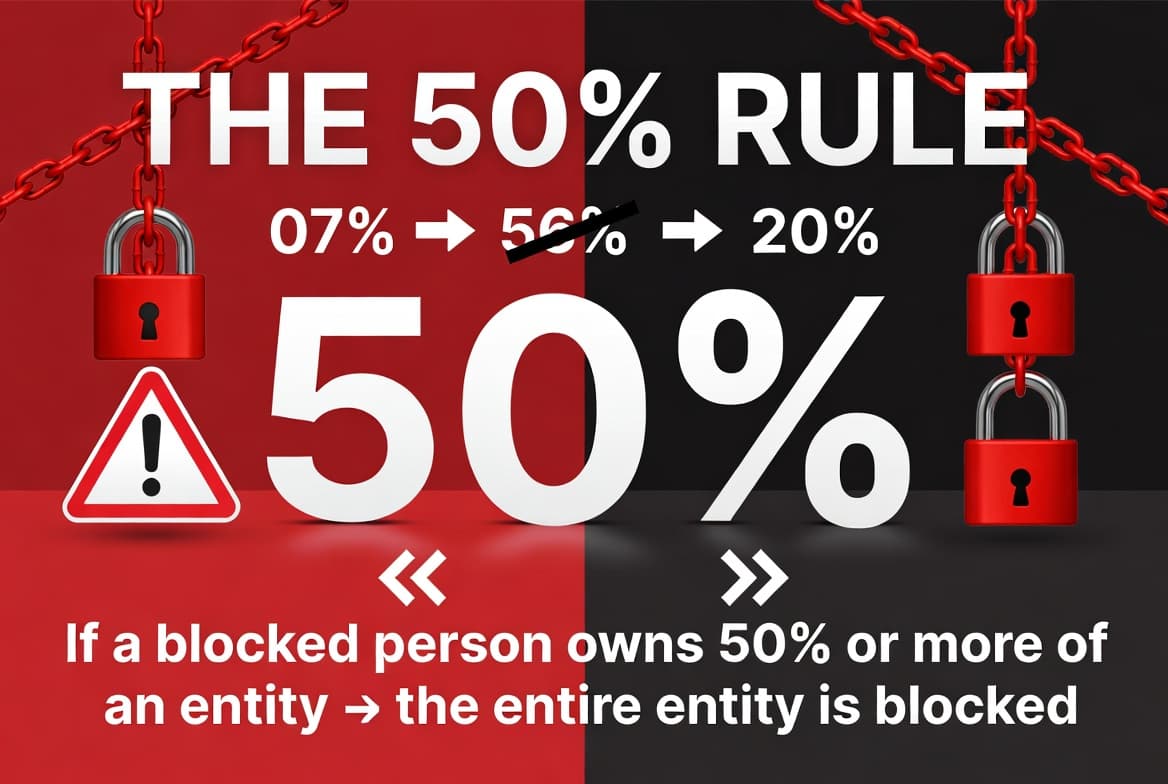
Teams use the 50 percent rule to ask a critical question: does this apparently clean entity inherit restrictions because listed or blocked parties own or control it? If ownership crosses policy thresholds, risk may apply even when the subsidiary itself is not explicitly named on a list.
EAR workflows add another layer. Under EAR § 734.4, de minimis analysis determines when foreign-made items with U.S.-origin content are subject to the EAR. Organizations often evaluate ownership, list exposure, and de minimis treatment together, because all three can change licensing and access decisions.
How this affects manufacturers and defense contractors
Manufacturers and defense contractors operate through dense supplier networks, joint ventures, and foreign affiliates. A supplier can pass basic name screening but still carry ownership risk through parent structures. If your team does not look through ownership, you can approve parties that later trigger export, sanctions, or contractual problems.
For controlled environments, this also affects who can enter and under what conditions. If a visitor represents an entity with unresolved ownership risk, organizations typically escalate review, tighten escort rules, and restrict access zones until compliance and legal teams resolve the case.
Calculation Examples
Example 1: Direct ownership crossing 50%
Company A is listed. Company A owns 55% of Supplier B. Supplier B is not listed by name.
Operational outcome: Supplier B should be treated as high risk because control is direct and above 50%. Procurement and visitor access should require escalation.
Example 2: Aggregate ownership
Listed Owner X holds 30% of Supplier C. Listed Owner Y holds 25% of Supplier C.
30 + 25 = 55% aggregate exposure. Even without a single majority owner, aggregate ownership can create equivalent control risk in many compliance frameworks.
Example 3: Indirect ownership chain
Restricted Parent R owns 60% of Holding H. Holding H owns 50% of Supplier D.
Effective ownership = 0.60 × 0.50 = 0.30 (30%). On its own, this may not cross a 50% threshold, but it is still a material red flag that should trigger enhanced review.
Add another restricted owner at 22% and the aggregate position can change quickly. This is why teams run recurring ownership checks, not one-time intake math.
Common misconceptions
“If the name is not on a list, we are safe.”
Name screening is necessary but not sufficient. Ownership and control can create hidden exposure.
“One-time screening is enough.”
Ownership changes. Policies and list content update. Controls must include periodic rescreening.
“Only procurement needs this analysis.”
Visitor access, vendor visits, and facility tours can all introduce the same compliance risk.
“A spreadsheet gives us auditability.”
Spreadsheets track data, but often fail to prove decision timing, versioning, and approver integrity.
How this affects visitor management
Visitor compliance is increasingly tied to entity compliance. If a visiting representative is tied to an organization with unresolved ownership exposure, the safest default is controlled escalation: additional review, access limits, and documented sponsor approval before entry to sensitive areas.
This is where integrated workflows matter. Screening, ownership intelligence, adjudication, and front-desk controls should be connected. Otherwise, one team sees the risk while another grants access without context.
Practical rule: if an entity appears to be 50%+ controlled by restricted parties, or if control is uncertain, do not treat the visitor as a standard clear pass.
Brief CTA
SecurePoint USA helps teams connect ownership-aware screening with physical visitor workflows, so high-risk parties are reviewed before access and every decision is captured in audit-ready evidence.
See ITAR workflow demoRelated content
FAQ
What is the 50 percent rule in export controls?
In export-compliance workflows, teams use a 50 percent ownership threshold to determine whether a non-listed company can still be treated as restricted because listed parties own or control it.
Does one 50 percent owner matter more than two 25 percent owners?
Both can be material depending on the applicable program. Aggregate ownership analysis is critical because multiple blocked or restricted owners can create equivalent risk.
How does EAR 734.4 relate to this topic?
EAR 734.4 addresses de minimis treatment for foreign-made items containing U.S.-origin content. Compliance teams often evaluate ownership and de minimis questions together in export-control risk reviews.
Can visitor management be affected by ownership risk?
Yes. If a visitor represents an entity with high-risk ownership, organizations typically require enhanced screening, additional approvals, and tighter access controls.
What is the biggest operational mistake teams make?
Relying on name matching without ownership look-through. Name screening alone misses affiliate and control risk.
Need to pressure-test your ownership workflow?
Review a real supplier or visitor scenario and validate where your current process can miss hidden control risk.
Book a 15-minute demo